
Empowering Seamless Digital Transformation in Manufacturing
In today’s dynamic industrial landscape, manufacturing companies face the growing imperative to adopt digital transformation strategies that streamline operations, foster agility, and drive innovation. Integration is at the heart of this digital journey, ensuring that disparate systems, applications, and data sources can communicate efficiently.
Two leading players enabling this transformation are QAD, a renowned provider of enterprise resource planning (ERP) solutions tailored for the manufacturing sector, and Boomi, a market-leading Integration Platform as a Service (iPaaS). Together, QAD and Boomi empower manufacturers to achieve seamless integration across their technology ecosystems.
Understanding QAD and Boomi
QAD is a global ERP provider specializing in solutions for manufacturing companies, covering industries such as automotive, life sciences, food & beverage, consumer products, and industrial products. Its ERP platform offers modules spanning supply chain management, production, finance, customer relationship management, and more.
Boomi offers a comprehensive iPaaS solution enabling rapid and reliable integration of cloud and on-premises applications, data, and processes. Its low-code development environment, extensive connector library, and cloud-native infrastructure make Boomi an ideal choice for organizations seeking agility and scalability in their integration projects.
The Integration Imperative in Manufacturing
Manufacturing companies often operate with a complex web of legacy systems, modern SaaS applications, machines, and IoT devices. The challenge is to unify these disparate platforms to foster realtime data sharing, process automation, and business intelligence.
Common integration challenges in manufacturing include:

Connecting legacy on-premises ERP systems with new cloud applications.
Enabling real-time data flow between production, inventory, logistics, and finance departments.
Integrating with external partners, suppliers, and customers for seamless supply chain collaboration.
Connecting shop-floor machinery and IoT sensors with enterprise systems for predictive maintenance and performance monitoring.
Ensuring data consistency and accuracy across multiple systems and processes.
QAD, when integrated using Boomi, provides a robust solution to these integration challenges, allowing manufacturers to break down silos and accelerate transformation.
How QAD and Boomi Work Together
The integration of QAD ERP with Boomi’s iPaaS enables manufacturing organizations to link their core business processes with a wide range of applications, databases, devices, and external partners. Key aspects of their synergy include:
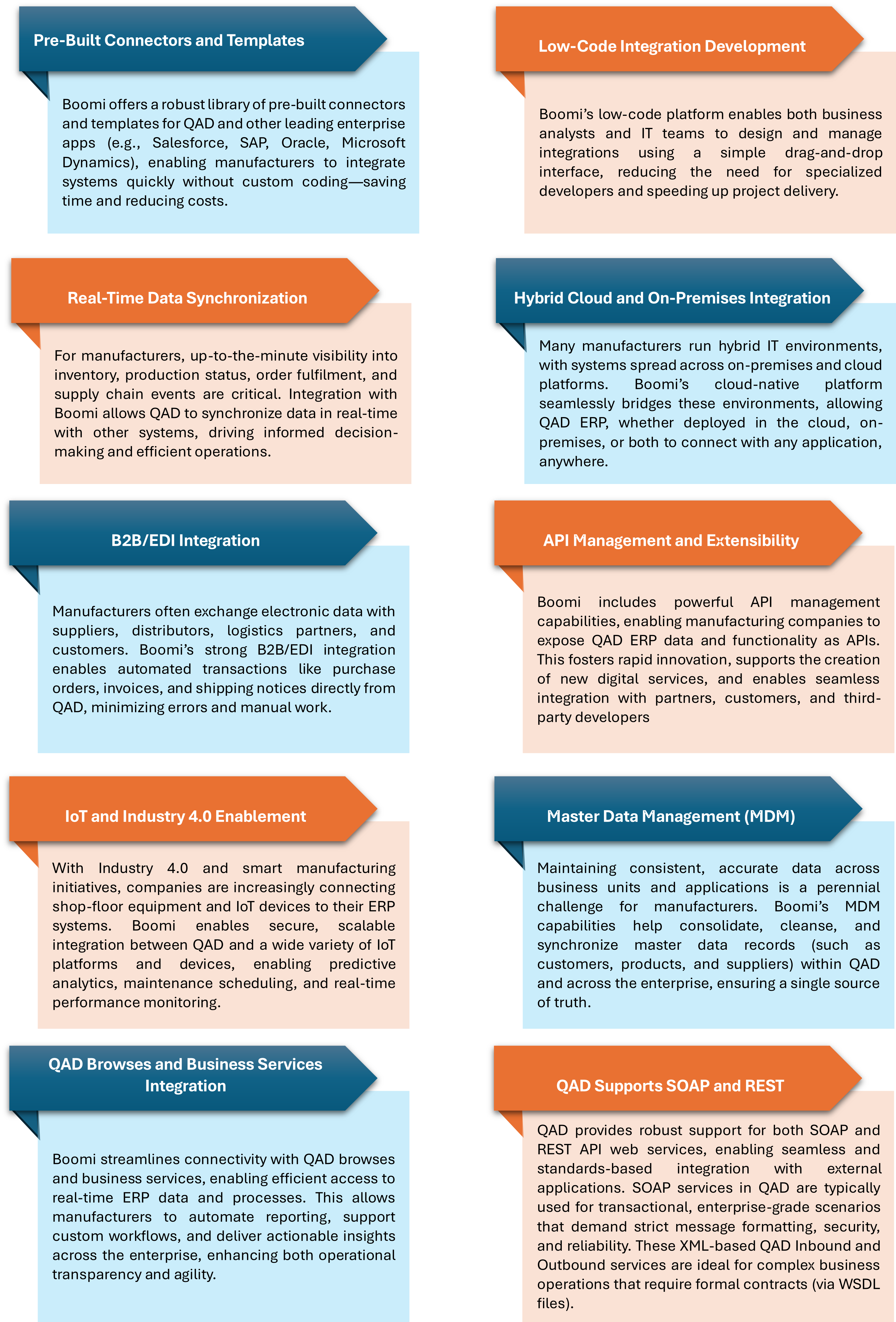
QAD’s Business Services REST APIs enable lightweight, stateless communication using standard HTTP methods (GET, POST, PUT, DELETE) and JSON data exchange. This makes it easier to develop and integrate with web and mobile apps, modern cloud platforms, and microservices. REST APIs are ideal for flexible, scalable, and loosely coupled integration scenarios.
Key Benefits for Manufacturing Companies
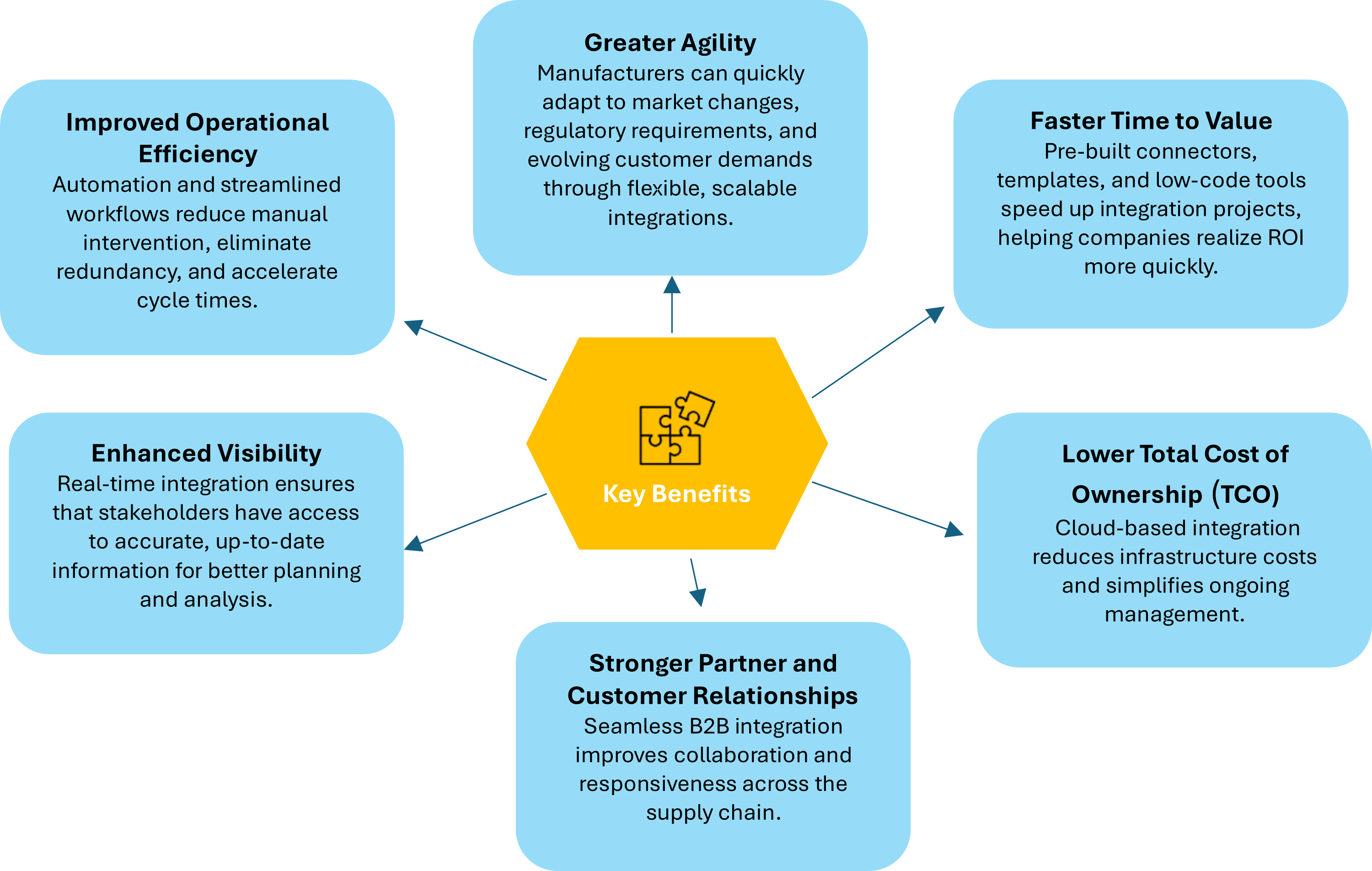
When QAD and Boomi are integrated, manufacturing companies realize transformative benefits, including:
Use Cases in Manufacturing
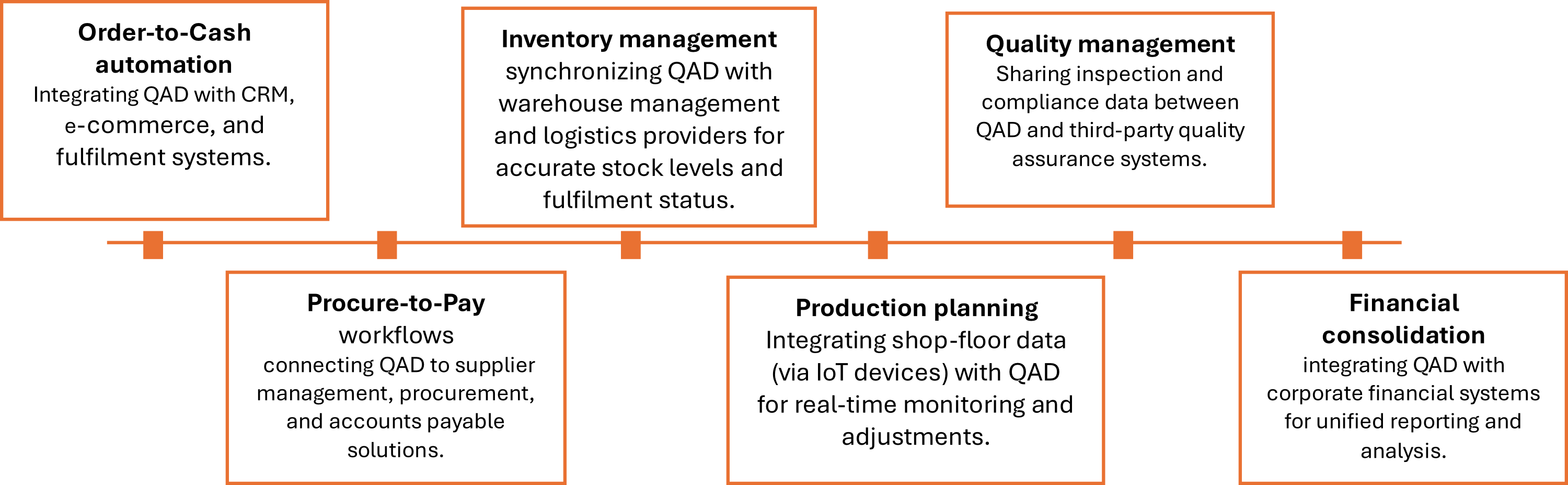
Manufacturing organizations leverage QAD and Boomi integration for a range of use cases, including:
Technical Integration Scenarios
Technical integration in manufacturing demands robust, low-latency data exchange across systems. Using Boomi, manufacturers can connect shopfloor IoT telemetry with QAD to stream real-time production data—such as machine uptime, output rates, and energy usage—enabling QAD-driven, rule-based planning that dynamically adapts to current conditions.
For quality management, API-level integration between QAD and third-party QA systems automates the transfer of inspection results, defect rates, and compliance records, providing instant feedback to both MES and ERP layers.
On the financial front, secure ETL pipelines between QAD and corporate consolidation platforms ensure continuous synchronization of ledger entries, cost allocations, and intercompany transactions supporting accurate and timely financial reporting.
Best Practices for Successful Integration
To maximize the value of QAD and Boomi integration, manufacturing companies should:
Step 1: Define clear Objectives or goals to be achieved

Step 2: Solution Design and Implementation
Digitus begins by engaging in in-depth consultations with the client to understand business processes, integration points, and desired outcomes. Leveraging deep expertise in QAD’s ERP modules and Boomi’s integration capabilities, the company proposes a tailored solution architecture that covers:
Process Mapping and System Assessment: Analysing current workflows, identifying manual touchpoints, and mapping data flows between QAD ERP and external systems (such as MES, CRM, logistics, or analytics platforms).
Integration Blueprint:Designing Boomi workflows to orchestrate QAD Browse queries and transactional API calls in response to real-world manufacturing events.
Connector Configuration:Utilizing Boomi’s pre-built connectors to rapidly integrate third-party applications, significantly reducing development time and cost.
Customization and Extensions: Configuring additional business logic, data transformations, and custom error handling to meet unique process requirements.
Security and Compliance: Implementing robust authentication, authorization, and audit mechanisms in line with industry standards.
Step 3: Solution Deployment
The company orchestrates a phased rollout:
Pilot Deployments:Performing initial integration in test environments – cloud or on-premises, validating data synchronization (real-time and batch), and conducting user acceptance testing (UAT).
Production Cutover: Managing the final switchover, ensuring minimal disruption and data integrity across QAD and connected applications.
Training and Enablement: Providing hands-on training for end-users and IT administrators, coupled with documentation and knowledge transfer to empower client teams.
Step 4: Support and Maintenance Services
A registered partner offers a suite of support and maintenance services, crucial for sustaining operational excellence:
Monitoring:Continuously tracking the performance of Boomi integrations, QAD ERP processes, and related APIs to proactively detect and resolve issues
Error Handling and Incident Response:Managing API errors, data discrepancies, and workflow failures, ensuring reliable and auditable information flows
Patches and Updates:Applying security patches, version upgrades, and enhancements to both QAD ERP and Boomi connectors to keep the environment current and secure.
Performance Optimization: Analysing integration bottlenecks, fine-tuning workflows, and recommending improvements to maximize system throughput and user satisfaction.
Change Management: Supporting new business requirements, onboarding new suppliers, or integrating additional applications through agile reconfiguration rather than custom development
Compliance and Audit Support: Maintaining detailed logs, access controls, and audit trails to meet regulatory and clientspecific compliance needs.
Step 5: Value-Added Services
Beyond technical support, the Digitus - QAD and Boomi partner acts as a strategic advisor by:
Identifying opportunities for process automation and continuous improvement.
Advising on industry best practices for manufacturing integration, data governance, and cloud adoption.
Facilitating innovation workshops to explore advanced analytics, IoT, or AI-driven enhancements leveraging the integrated QAD-Boomi foundation.
Conclusion
Digitus, a registered IT services partner with QAD and Boomi, is uniquely positioned to provide comprehensive solutions that seamlessly connect, optimize, and future-proof manufacturing operations. With expertise in solution design, smooth implementation, and reliable ongoing support, the company delivers tangible business value—enabling manufacturers to enhance agility, boost efficiency, and gain deeper insights in an ever-evolving market.